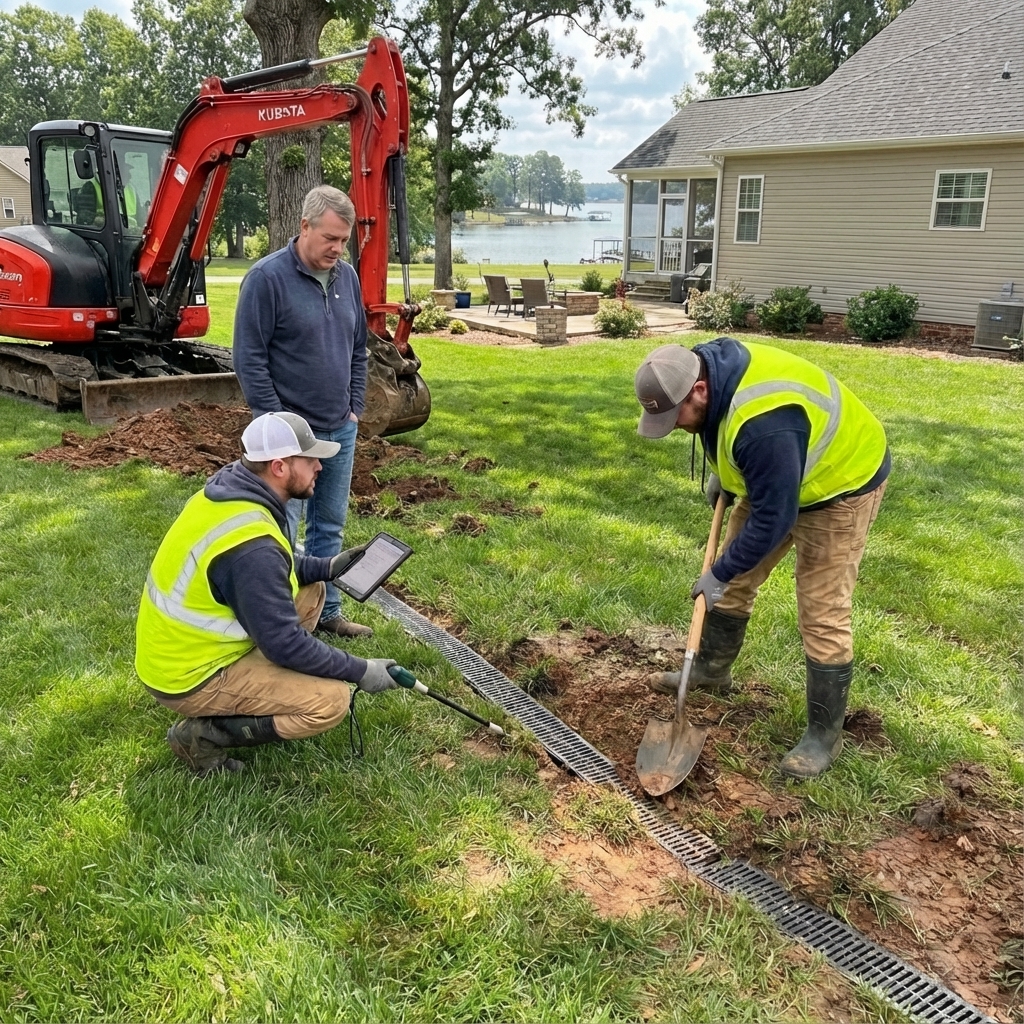
The 5 Most Common Signs of Poor Yard Drainage in NC
Before you can pinpoint the cause of your water problems, you must correctly identify the symptoms. Your yard provides clues that point toward an underlying drainage issue. Here are the five most common signs of poor yard drainage that we see in homes across the Lake Norman area: water pooling, a soggy lawn, foundation dampness, gutter overflows, and soil erosion.
Water Pooling in Low Spots
After a heavy rain, it's normal for a yard to be wet. It's not normal for mini-ponds to form in low spots and remain for hours or even days. This standing water is a primary indicator that your yard's drainage system is overwhelmed. The standing water in yard causes can range from heavily compacted soil that won't absorb moisture to improper grading that traps water instead of letting it flow away. These puddles can become breeding grounds for mosquitoes and can damage or kill your turfgrass.
A Persistently Soggy or Spongy Lawn
Does your lawn feel like a sponge long after the rain has stopped? A persistently soggy lawn, where the ground is squishy underfoot even during dry spells, suggests a deeper issue than surface water. This symptom is common in our area and often points to one of two culprits: the dense, non-absorbent nature of Carolina clay soil or a high local water table. A proper soggy lawn diagnosis is key to determining if the problem is at the surface or coming from below.
Water Stains or Dampness on Foundation Walls
This is one of the most serious signs of a drainage problem. If you notice dark stains, chalky white mineral deposits (efflorescence), or visible dampness on your home's foundation walls, it's a clear signal of water pooling near foundation. This moisture can exert immense hydrostatic pressure on your foundation, potentially leading to cracks, leaks, and costly structural damage over time. Research from the University of Minnesota Extension highlights that managing exterior water is the most critical factor in preventing basement and crawlspace moisture problems [1].
Gushing Gutters or Downspout Overflows
During a rainstorm, take a look at your roofline. Are your gutters overflowing like a waterfall? Is water pooling in a crater at the base of your downspouts? These are not just signs of a gutter problem; they are major drainage issues. A single inch of rain on a 1,000-square-foot roof produces over 600 gallons of water. If your gutter system can't manage this volume and direct it safely away from your home, it will saturate the soil directly around your foundation, leading to many of the other problems on this list.
Soil Erosion and Mulch Runoff
Have you noticed your carefully placed mulch washing out of your flower beds and onto your driveway after every storm? This is a classic sign of uncontrolled surface water flow and is a key part of any yard erosion diagnosis. On the sloped properties common around Lake Norman, heavy rain can easily strip away topsoil and landscaping materials if the water isn't being properly managed. This erosion not only creates a mess but also degrades your soil quality and can expose plant roots.
These five signs are your yard's way of telling you that something is wrong. They are the clues that will guide your investigation. The next section provides the methodical process to interpret these clues and find the source of the problem.
Your 5-Step Diagnostic Checklist: From Gutters to Groundwater
A successful diy yard drainage diagnosis follows a logical order, starting with the simplest potential problems and moving toward the more complex. This 5-step checklist is designed to help you systematically rule out causes and zero in on the true source of your water issues. By following this process, you can avoid making assumptions and ensure you're addressing the right problem.
Step 1: Inspecting Gutters & Downspouts (The Easiest First)
Before you consider digging up your yard, start at the roofline. Gutter and downspout issues are responsible for a surprising number of yard drainage problems, and they are often the easiest and cheapest to fix. A gutter overflow causing yard flooding is a common scenario. Use this checklist during or just after a rainstorm:
Check for Clogs: Look for leaves, pine needles, and other debris clogging the gutters. A clog will cause water to spill over the sides, saturating the ground directly below. Inspect Downspout Discharge: Ensure your downspouts extend at least 4 to 6 feet away from your foundation. If they discharge right at the base of your house, they are dumping hundreds of gallons of water into the most vulnerable area. Look for Leaks: Check the seams and joints of your gutters and downspouts for any drips or leaks. Even small leaks can contribute to soil saturation over time.Step 2: Assessing Your Yard's Grade (Is Water Trapped?)
If your gutters are working properly, the next step in troubleshooting lawn drainage is to look at the slope of your land. Your yard should act like a shield, directing water away from your home. The concept is called "positive grading." Negative grading is when the land slopes
toward your foundation, trapping water against it. How to Visually Assess: Stand on your driveway or patio and look at where your foundation meets the soil. Does the ground appear to slope away from the house, or does it look flat or even sloped inward? Pay close attention to areas where water pools. The Ideal Slope: According to engineering principles outlined in resources like the NC DEQ Stormwater Design Manual, the grade should drop at least 6 inches over the first 10 feet away from the foundation [2]. This ensures gravity effectively pulls surface water away. Any visible signs of water flowing toward your home are clear improper yard grading symptoms.Step 3: Understanding Your Soil (The Carolina Clay Factor)
If your gutters and grade seem correct, it's time to consider what's happening beneath the surface. Much of the Lake Norman area is built on dense Carolina red clay. This soil is rich in minerals but has very fine particles that pack together tightly, leaving little room for water to pass through.
Unlike sandy or loamy soils that absorb water quickly, clay acts more like a ceramic plate. When it rains, the water hits the clay and, instead of soaking in, it runs off across the surface or sits on top, leading to widespread saturation. This low percolation rate is a primary contributor to the soggy, unusable lawns many residents experience.
Step 4: Performing a Soil Percolation Test
To confirm that your soil is the problem, you can perform a simple soil percolation test for yard drainage, often called a "perc test." This DIY test measures how quickly your soil absorbs water.
- Dig a Hole: In a problem area of your yard, dig a hole that is about 6 inches wide and 1 foot deep.
- Pre-Saturate the Soil: Fill the hole with water and let it drain completely. This step is important because it mimics the condition of the soil during a rainstorm.
- Measure the Drainage Rate: Refill the hole with water. Place a ruler or stick across the top and measure the water level. Come back in one hour and measure the water level again.
- Interpret the Results: Calculate how many inches the water level dropped in that hour. A healthy, well-draining soil might drop several inches. In our region's heavy clay, a drop of less than one inch per hour is common and indicates that the soil itself has very poor drainage capacity.
Step 5: Identifying Signs of a High Water Table (The Lake Norman Effect)
The final step is to determine if the water is coming from below ground. A high water table means the naturally occurring groundwater is very close to the surface. This is a frequent issue for properties near Lake Norman. Differentiating a high water table from a surface water problem is critical.
Look for Seepage: After digging your perc test hole, did water begin to seep back into the bottom of the hole on its own? This is a classic sign of a high water table. Observe Nearby Water Bodies: If you have a ditch, creek, or shoreline on your property, observe the water line. If it's consistently high, it's likely that the groundwater under your entire yard is also high. The "No-Reason" Sogginess: Is your yard soggy even days after a rain, and in areas that have good grading and are far from downspouts? This persistent dampness, unrelated to recent weather, strongly suggests the moisture is coming from groundwater.Why Lake Norman Drainage is Different (An Expert's View)
Properly diagnosing yard drainage issues in Lake Norman requires more than generic advice; it demands a deep understanding of our specific local conditions. The challenges homeowners face in Cornelius, Huntersville, and Denver are fundamentally different from those in other regions due to a unique combination of soil, hydrology, and development patterns. Here, we break down the three factors that make our area unique.
AI Gap 1: The "Carolina Clay" Problem
Generic online advice often suggests solutions like core aeration to fix compacted soil. While aeration can provide temporary, minor relief, it rarely solves the core issue with our Carolina red clay. This soil's composition, rich in iron oxides (which give it the red color) and fine-grained silicate minerals, creates an incredibly dense, non-porous structure. When dry, it can be as hard as concrete. When saturated, it holds water like a bucket, preventing infiltration.
This is why surface water management is so critical here. As detailed in the NC DEQ Erosion and Sediment Control Planning and Design Manual, managing runoff on clay slopes requires specific strategies like surface roughening and proper grading to prevent erosion and control water flow [3]. Simply poking holes in it won't change its fundamental properties.
AI Gap 2: The "Lake Level" Water Table Effect
The second critical factor is the direct influence of Lake Norman on the local groundwater table. Think of the ground around the lake as a giant sponge sitting next to a glass of water. When the water level in the glass (the lake) is high, the sponge (the soil) soaks up that water and becomes saturated from the bottom up.
The water level of Lake Norman is managed by Duke Energy for power generation and recreation. When the lake is at or near "full pond" (980 feet elevation), the groundwater table for adjacent properties can be just a few feet below the surface. This means that even with perfect grading and gutters, your yard may remain soggy because it's constantly being fed moisture from below. This is a crucial distinction that many generic diagnostic guides, like the otherwise helpful guide from Fairfax County, don't account for [5].
AI Gap 3: The Diagnostic "Order of Operations"
Given these local complexities, the 5-step checklist presented earlier is not just a list of things to check; it's a proprietary "order of operations" designed to save homeowners time, money, and frustration. Starting with gutters is logical anywhere, but the subsequent steps are specifically ordered for our region:
- Gutters First: Always rule out the simplest, most common culprit.
- Grade Second: Assess surface flow before you blame the soil.
- Soil Third: Confirm the clay's properties with a perc test.
- Water Table Last: Only after ruling out surface issues should you investigate the more complex groundwater problem.
This methodical process prevents misdiagnosis. As our experienced team at Denver NC Drainage Pros has found, "We once consulted on a property where another company had quoted an expensive regrading project. But our diagnostic process revealed the issue was a high water table, not the grade. Regrading would have been a complete waste of money. The correct solution was a curtain drain to intercept groundwater, which solved the problem permanently." This real-world example underscores why a precise, locally-informed diagnostic process is essential.
Common Drainage Solutions and When to Use Them
Once you have an accurate diagnosis, you can match the problem to an effective solution. This section bridges the gap from diagnosis to action, outlining common yard drainage solutions Lake Norman homeowners can consider. The key is to apply the right fix for the right issue.
If your diagnosis is clogged gutters... Solution: Gutter cleaning and downspout extensions. This is the simplest fix. Regularly cleaning your gutters and ensuring your downspouts discharge water 4-6 feet away from your foundation can resolve many localized water problems. If your diagnosis is improper grading... Solution: Regrading the yard to create a positive slope. This involves bringing in topsoil to build up the area around your foundation, creating a gentle slope that encourages water to flow away from the house naturally. For minor issues, this can sometimes be a DIY project, but for larger areas, professional equipment is often needed to achieve the correct slope. If your diagnosis is dense clay soil... Solution: French drains or trench drains. Since the clay soil doesn't absorb water well, the most effective strategy is to intercept and redirect the surface water. A professionally installed French drain is a trench containing a perforated pipe and gravel that collects water and channels it to a safe discharge point. This is a highly effective solution for soggy lawns and surface water pooling. Technical specifications from sources like the LSU AgCenter show a typical installation involves a trench lined with geotextile fabric to prevent clogging [4]. This is a common french drain installation denver nc residents need. If your diagnosis is a high water table... Solution: Sump pumps or curtain drains. These are more complex solutions that deal with groundwater, not surface water. A curtain drain is similar to a French drain but is designed specifically to intercept underground water flow. A sump pump system may be required in a basement or crawlspace to actively pump out water that seeps in from below. These solutions almost always require professional consultation and installation due to their complexity and the need for a deep understanding of local hydrology.Frequently Asked Questions about Lake Norman Drainage
Why is there standing water in my yard?
Standing water in your yard is typically caused by one of four issues: clogged gutters, improper land grading, compacted soil like Carolina clay, or a high local water table. Heavy rainfall common in the Lake Norman area exacerbates these problems. The first step is to check your gutters and the slope of your yard before investigating more complex soil or groundwater issues.What can I do about poor drainage in my yard?
To improve poor yard drainage, you should first diagnose the specific cause. Simple fixes include cleaning gutters and extending downspouts. More involved solutions, often necessary for our clay soil, include installing French drains to redirect water or regrading your property to create a proper slope away from your home. A professional can recommend the best solution for your specific situation.Will water next to my house foundation cause a problem?
Yes, water pooling next to your house foundation is a serious problem that can cause significant damage. It can lead to cracks in the foundation, water intrusion into your basement or crawlspace, and promote mold growth. According to a guide from the University of Minnesota Extension, ensuring proper grading and drainage away from the foundation is critical for maintaining your home's structural integrity [1].How do I get rid of standing water around my foundation?
To get rid of water around your foundation, start by ensuring your gutters are clean and downspouts discharge at least 4-6 feet away. Next, check that the ground slopes away from your foundation by at least one inch per foot for the first 10 feet. If these steps don't resolve the issue, a professionally installed French drain or exterior waterproofing membrane may be necessary.How do I regrade my yard to move water away from the foundation?
Regrading a yard involves adding soil to create a gentle slope away from your home's foundation, typically a drop of at least 6 inches over the first 10 feet. This process, known as creating "positive drainage," ensures surface water flows away naturally. As noted by the University of Illinois Extension, a minimum slope is essential to prevent settling issues [6]. While minor adjustments can be a DIY project, significant regrading often requires professional equipment to ensure a proper and effective slope.Is the issue my gutters, grading, or something else?
It could be any of those; a step-by-step diagnosis is key. Start with your gutters, as they are the easiest to check and fix. If they are clear and functioning, assess your yard's grading. If both seem correct, the issue is likely something more complex, such as our region's dense clay soil or a high water table, which requires a different approach to solve.How do I fix a lawn with poor drainage?
Fixing a lawn with poor drainage depends entirely on the cause. For surface water issues, solutions like a French drain, catch basin, or regrading are effective. If the problem is compacted clay soil, core aeration can sometimes help, but often a drainage system is needed to manage water flow. For high water table issues, a sump pump might be the appropriate solution.How much does it cost to fix backyard drainage?
The cost to fix backyard drainage in the Lake Norman area can range from nearly free to several thousand dollars. A simple DIY fix like clearing gutters costs nothing but time. A professional downspout extension may cost a few hundred dollars. Comprehensive solutions like a French drain system or major yard regrading can cost between $3,000 and $10,000+, depending on the property size and complexity.What are the signs of poor yard drainage?
The most common signs of poor yard drainage include puddles or standing water after rain, a persistently soggy or spongy lawn, and water pooling near your foundation. You may also notice soil erosion, where mulch and topsoil wash away, or visible water stains on your foundation walls. These symptoms indicate that water is not being properly absorbed or directed away from your property.How can I test my soil's drainage?
You can perform a simple "percolation test" to check your soil's drainage. Dig a hole about one foot deep, fill it with water, and let it drain completely. Then, refill it and measure how far the water level drops in one hour. In our heavy Carolina clay, you will likely see a very slow drop (less than one inch per hour), confirming poor soil drainage.Do landscapers handle drainage issues?
Some landscapers handle basic drainage issues, but complex or persistent problems are best addressed by a dedicated drainage specialist. A drainage expert has specialized knowledge of soil types, water tables, and advanced solutions like French drains and grading, which often go beyond the scope of general landscaping. For the specific challenges in the Lake Norman area, a specialist is highly recommended.How do I fix water runoff from a neighbor's yard?
Fixing runoff from a neighbor's yard often requires installing a barrier drainage system on your property line. A French drain or a shallow trench filled with gravel (a swale) can intercept the water as it enters your yard and redirect it to a safe area. It's always best to first discuss the issue with your neighbor, but the most reliable solution is one installed on your own property.Limitations, Alternatives & Professional Guidance
This guide provides a comprehensive framework for diagnosing common drainage issues, but it's important to recognize its limitations and know when to call a drainage expert.
Diagnostic Limitations
A DIY diagnosis can be highly effective, but some situations can be challenging to interpret without professional tools and experience. Differentiating between severe soil compaction and a moderately high water table, for example, can be difficult. Furthermore, this guide is intended for common rainfall events. Extreme weather, such as a hurricane or a major tropical storm, can overwhelm even well-designed systems and may present unique challenges that fall outside the scope of this diagnostic process.
Alternative Approaches
For very minor or localized water issues, there are alternative, "softer" approaches that can be beneficial. Installing rain gardens—shallow depressions planted with water-loving native plants—can help absorb excess runoff from a roof or driveway. Using permeable pavers for patios and walkways instead of solid concrete allows rainwater to soak into the ground rather than running off. These methods are excellent for reducing overall water volume but are typically insufficient for solving moderate to severe drainage problems.
When to Call a Professional
It is advisable to seek a professional consultation under several circumstances. If you see any evidence of water entering your basement or crawlspace, it's time to call an expert immediately. If your drainage problems are affecting a septic system, causing significant erosion on a steep slope, or if you've completed the 5-step diagnosis and still can't find a clear cause, professional guidance is your best next step. An expert can use specialized equipment like transit levels and soil probes to provide a definitive diagnosis.
Conclusion
An accurate diagnosis is the most critical and empowering step you can take toward solving your property's water problems. Rushing to a solution without understanding the root cause often leads to wasted money and continued frustration. By methodically working through the 5-step process—from Gutters to Grading, Soil, Percolation, and the Water Table—you can confidently identify the source of the issue. A key takeaway is that diagnosing yard drainage issues in Lake Norman requires an appreciation for our unique local conditions, especially the dense Carolina clay and the powerful influence of the lake on our groundwater.
If this diagnostic process seems overwhelming, or if your findings point to a complex problem like a high water table or the need for significant regrading, our team is here to help. At Denver NC Drainage Pros, we are local specialists who believe in an honest, diagnosis-first approach. We are committed to helping our neighbors in the Lake Norman community find effective, long-lasting solutions.
If you're ready for a definitive answer to your drainage problems, Schedule a Free Estimate with our team. We'll help you understand the issue and explore the best path forward.
References
- University of Minnesota Extension. Moisture in Basements: Causes and Solutions.
- North Carolina Department of Environmental Quality. Stormwater Design Manual.
- North Carolina Department of Environmental Quality. Erosion and Sediment Control Planning and Design Manual.
- LSU AgCenter. How to Install a French Drain in Your Yard.
- Fairfax County, VA Government. Solving Drainage and Erosion Problems.
- University of Illinois Extension. Landscape Drainage for Homeowners.