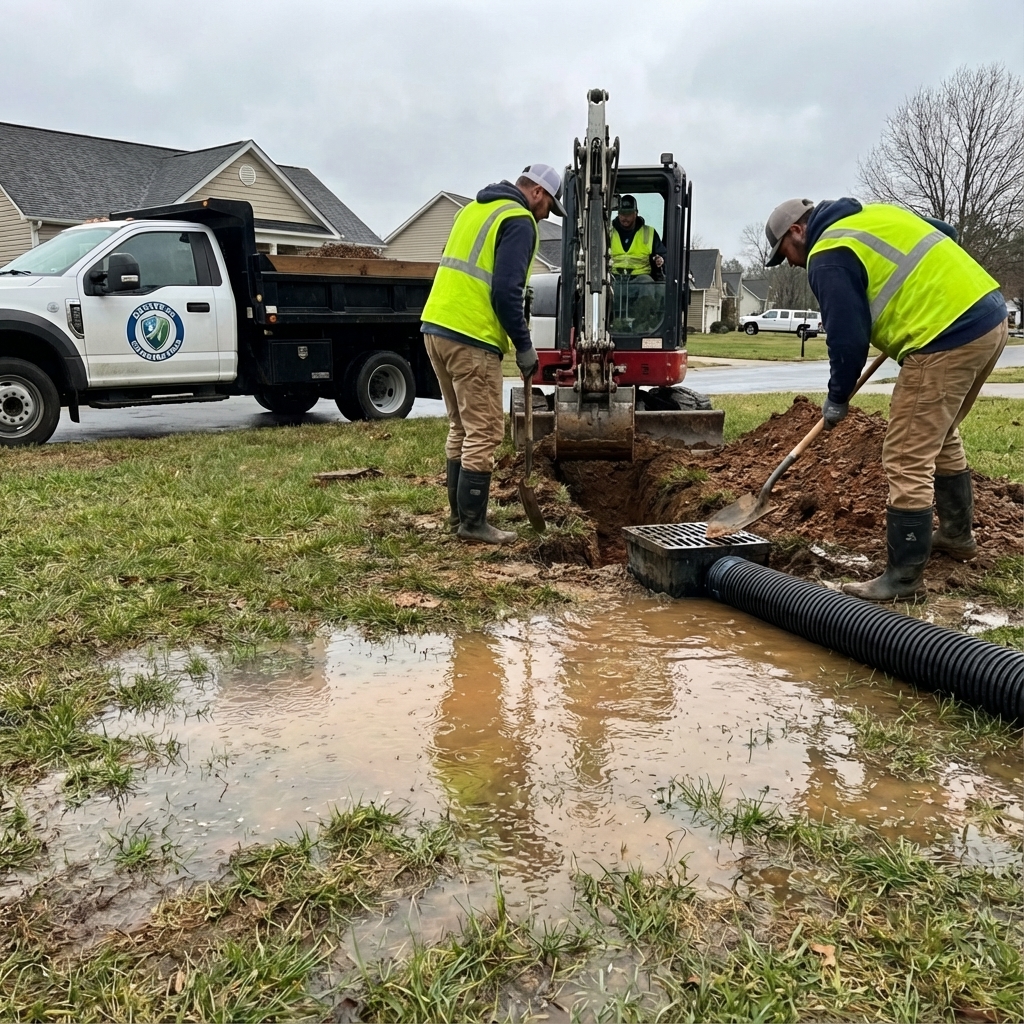
Why Your Denver, NC Yard is a Soggy Mess: The Red Clay Problem
Your yard's drainage problem is primarily caused by the dense, compacted nature of North Carolina's red clay soil, which has very low permeability. Composed of extremely fine mineral particles with very little space between them, this soil type acts more like a solid basin than a filter. When it rains, water hits the surface and simply sits there, unable to soak into the ground. This leads to the common and frustrating issue of standing water in a yard with clay soil.
The structure of our local red clay is the root of most clay soil drainage problems. Unlike sandy soil, which has large particles that allow water to pass through quickly, or loamy soil, which has a balanced mix of sand, silt, and clay, our soil holds onto water tenaciously. This low porosity means that even a moderate rainfall can oversaturate the top layer of your yard, creating a muddy, unusable surface. The question of will water drain quickly through a clay-rich soil has a clear answer here: no, it will not.
You can identify the signs of poor yard drainage easily:
The local climate in the Denver and Lake Norman area, with its high humidity and potential for heavy downpours, only exacerbates these issues. Without intervention, a soggy lawn won't fix itself. Over time, it can lead to more severe problems, including root rot in your plants and trees, soil erosion, and costly foundation damage. As guidance from the University of Minnesota Extension highlights, poor exterior grading and drainage are primary causes of moisture seeping into basements and damaging foundations [3]. Now that the "why" behind your soggy yard is clear, let's explore the "how-to" of fixing it.
DIY Fixes: How to Improve Clay Soil Drainage on Your Own
You can improve your clay soil's drainage by incorporating organic matter and performing regular core aeration to create pathways for water to penetrate. For homeowners with mild to moderate drainage issues, these diy yard drainage for clay soil methods can be a great first step toward a healthier lawn. They focus on changing the structure of the soil itself, making it more porous and absorbent over time.
Here are four steps you can take to start improving your lawn's drainage.
Step 1: Amend the Soil with Organic Matter
One of the most effective long-term strategies is to improve the soil's composition. This involves working rich organic matter into the top few inches of your clay. Good soil amendments for clay soil drainage include high-quality compost, aged pine bark fines, or leaf mold. These materials introduce larger particles and air pockets into the dense clay, creating channels for water to move through. A common question is, is it better to amend clay soil in fall or spring? In our region, fall is often an ideal time, as it gives the organic matter a full winter to begin breaking down and integrating. It's critical to avoid adding sand to clay soil; instead of improving drainage, this combination can create a concrete-like substance that makes the problem even worse.
Step 2: Perform Core Aeration
Compaction is a major enemy of drainage in clay soil. Core aeration for clay soil is the process of using a machine to pull small plugs, or "cores," of soil out of the lawn. This process directly combats compaction by creating thousands of small holes that allow water, air, and nutrients to penetrate deeper into the root zone. You can rent a core aerator from a local equipment supplier for a weekend project. For best results, aerate when the soil is moist but not saturated.
Step 3: Check Your Yard's Grading
Sometimes, the problem isn't just the soil but the slope of your yard. Your property should have a gentle, consistent slope away from your house to direct surface water away from the foundation. According to guidance from the University of Illinois Extension, a final grade with a minimum slope of 4% away from a house is recommended to ensure proper surface runoff [5]. You can check this with a long level and string line. If you find low spots or areas that slope toward your home, you may need to add topsoil to correct the grade.
Step 4: Manage Your Gutter Downspouts
A significant amount of water can be deposited in one spot by your home's gutter system. If your downspouts empty directly at the base of your foundation, they are contributing heavily to soil saturation in that area. A simple but highly effective fix is to add extensions to your downspouts, ensuring they discharge water at least 4-6 feet away from your house, preferably onto a sloped surface that carries the water further away.
These DIY steps can make a noticeable difference for many homeowners. However, if you've tried these methods and are still dealing with persistent standing water, it may indicate a more significant underlying issue that requires an engineered drainage solution.
The Denver Drainage Difference: Local Costs, Codes, and Clay
Generic online advice for fixing a soggy lawn often fails homeowners in Denver and the greater Lake Norman area. An article written for sandy Florida soil or a chatbot that pulls national data simply cannot account for the three critical factors that define our local drainage challenges: the unique properties of our red clay, North Carolina's specific environmental regulations, and the true cost to install french drain systems and other solutions in our market. As a trusted local yard drainage contractor denver nc, we understand that a successful project requires deep regional expertise. This section provides the specific, on-the-ground details you can only get from a seasoned professional who works with this soil every day.
NC Red Clay Isn't Just "Clay"
The soil here is classified as Ultisols, a soil order known for its distinct reddish color and high clay content. But its challenges go beyond that. Our red clay has high plasticity, meaning it expands when wet and shrinks and cracks when dry. During our humid summers and wet winters, it becomes heavily compacted, squeezing out the air pockets water needs to travel through. This compaction is so severe that it can create a nearly impermeable layer known as a hardpan just below the surface, which is a primary cause of standing water. Freeze-thaw cycles in the winter can also cause the soil to "heave," further disrupting any natural drainage channels. To effectively improve lawn drainage nc, any solution must be built to withstand these specific conditions.
Local Regulations You Must Follow
When installing any drainage system, you aren't just moving water; you are managing stormwater runoff, which is regulated at the state level. Professionals must design and build systems that are compliant with official state guidelines, such as those outlined in the NC DEQ Stormwater Design Manual [1]. This manual provides the Minimum Design Criteria for ensuring that runoff is managed responsibly. Furthermore, any significant excavation or grading work must adhere to the best practices found in the NC DEQ Erosion and Sediment Control Manual to prevent soil from washing into local waterways [6]. Working with a professional ensures your project is not only effective but also environmentally compliant.
Sourcing the Right Materials Locally
The long-term success of a French drain depends entirely on using the correct materials. In Lincoln County, this means sourcing #57 stone, which is a specific size of washed gravel that allows for optimal water flow without compacting. It's equally critical to use a professional-grade, non-woven geotextile fabric to line the trench. This fabric acts as a filter, preventing the surrounding clay and silt from migrating into the gravel and clogging the system over time—a common failure point for DIY or improperly installed drains.
Real-World Costs in Denver, NC
While national averages for a French drain are broad, here in the Denver area, homeowners can typically expect a professionally installed system to cost between $45 and $65 per linear foot. This price reflects the higher labor cost associated with trenching in our dense, heavy clay, the use of premium materials like #57 stone and geotextile fabric, and proper disposal of the excavated soil.
Expert Perspective: "The most common mistake we see is when homeowners try to apply a 'one-size-fits-all' solution they saw online. They might dig a shallow trench and fill it with the wrong type of rock, without the protective fabric. In our clay, that system will fail within a year or two. A proper installation is an investment, but it's designed to last for decades."
Professional Drainage Solutions for NC Clay
For significant standing water in clay soil, a professionally installed French drain is often the most effective and durable solution. Unlike surface-level fixes, a French drain is an engineered system designed to intercept, collect, and redirect both surface and subsurface water away from problem areas. It works by creating an easy underground path for water to follow, offering a permanent remedy for even the most stubborn soggy lawns.
How a French Drain Works in Clay
A french drain installation clay soil project involves more than just digging a ditch. A professional installation follows a precise process:
- Trenching: A trench is excavated at a specific depth and with a consistent slope to ensure gravity effectively moves the water.
- Fabric Lining: The trench is lined with a non-woven geotextile fabric, which is the key to longevity. This barrier allows water to pass through but stops silt and clay particles from clogging the system.
- Pipe and Gravel: A perforated pipe is laid at the bottom of the trench, and the entire trench is then filled with washed gravel (typically #57 stone). The gravel provides a highly porous medium for water to flow through easily.
- Finishing: The fabric is folded over the top of the gravel, and the system is finished with a layer of topsoil and sod, making it completely invisible.
According to technical guidance from the LSU AgCenter, best practices for French drains often involve trenches 12-18 inches wide and 18-24 inches deep to provide sufficient capacity [2]. The how deep should a french drain be question depends on the specific site, but these dimensions serve as a reliable standard. When you hire experts for a professional French drain installation, you ensure every component is correctly sized and placed for maximum effectiveness in our region's soil.
Other Professional Solutions
While French drains are a premier solution, other systems can be effective depending on the situation.
Dry Creek Beds: These are decorative and functional trenches filled with larger river rocks and stones. They are designed to look like a natural creek bed and are excellent for managing heavy surface runoff from sloped areas or downspouts, channeling it attractively across your property. Swales: A swale is a broad, shallow channel with gently sloping sides covered in grass. When comparing afrench drain vs swale, a swale manages surface water, while a French drain manages subsurface water. As explained in a homeowner guide by Fairfax County, swales are effective for redirecting slow-moving water across a lawn [4].
Yard Regrading: For properties with significant and widespread slope issues, professionally regrading the entire yard may be the most comprehensive solution. This involves using heavy equipment to reshape the land, ensuring water flows away from the home and off the property entirely.
Choosing the right system depends on a thorough evaluation of your property's slope, soil conditions, and the specific nature of your water problem. Because of the complexities of working with heavy clay, professional installation is highly recommended to ensure these systems are built correctly and provide a lasting solution to your drainage woes.
Frequently Asked Questions
How do you get rid of standing water in clay soil?
The most effective way to get rid of standing water in clay soil is by installing a drainage system like a French drain. This system collects excess water in an underground trench and pipes it away from the problem area. For less severe issues, improving the soil structure by adding organic compost and performing regular core aeration can also help increase water absorption over time.Who to call for standing water in a yard?
For standing water in your yard, you should call a professional landscape drainage contractor. These specialists have the expertise to diagnose the root cause of the problem, whether it's soil compaction, improper grading, or the need for an engineered solution. In the Denver, NC area, a local drainage expert is best equipped to handle challenges specific to our red clay soil.What is the average cost for a 100 ft French drain?
The cost for a 100 ft French drain in the Denver, NC market can vary based on depth and complexity, but homeowners should budget for a professional installation. Costs are influenced by labor for digging in dense clay, material quality, and site accessibility. It is always best to get a detailed, on-site estimate from a local contractor for an accurate price.Does wetting clay soil make it easier to dig?
Slightly moistening dry, hard-packed clay soil can make it easier to dig, but oversaturating it will turn it into heavy, sticky mud that is extremely difficult to work with. The ideal condition is lightly damp, not wet. Trenching in NC clay often requires specialized equipment, even when moisture levels are optimal, due to its density and weight.How to turn clay soil into well-drained soil?
To turn clay soil into well-drained soil, you must amend it with several inches of organic matter like compost, aged bark, or leaf mold. This process, repeated over several seasons, improves soil structure and creates air pockets for water to flow through. For immediate and significant drainage improvement, however, installing a French drain is often necessary.What is the best drainage system for clay?
A French drain is typically one of the most reliable drainage systems for heavy clay soil. Because clay absorbs water so slowly, a French drain effectively intercepts and removes excess surface and subsurface water. It collects water in a gravel-filled trench and uses a perforated pipe to channel it away from the problem area before it can saturate your lawn.Can you put topsoil on top of clay soil?
Yes, you can put topsoil on top of clay soil, but you should till it into the top few inches of the clay first. Simply layering topsoil on top can create a water barrier where the two different soil types meet, which can hinder drainage. Blending them together helps improve the structure of the clay's surface and promotes better water movement and root growth.What are the downsides of a French drain?
The primary downsides of a French drain are the installation cost and the potential for clogging if not installed correctly. A proper installation requires significant labor and materials. If a high-quality geotextile fabric isn't used, silt and soil from the surrounding clay can eventually clog the gravel and pipe, reducing its effectiveness over time. Professional installation mitigates this risk significantly.Limitations, Alternatives & Professional Guidance
While this guide provides a comprehensive overview based on extensive field experience and soil science, it's important to acknowledge certain limitations. Every property is unique, and factors like soil composition can vary even within the same neighborhood. The effectiveness of any solution will depend on your yard's specific slope, the depth of the local water table, and the location of underground utilities. The principles discussed here are sound, but individual results may vary based on these site-specific conditions.
Beyond the solutions detailed above, other alternative approaches may be suitable for specific situations. For example, a rain garden can be a beautiful and ecologically friendly way to manage and absorb runoff from a downspout in a contained, low-lying area of your yard. For minor surface water issues on a property with a clear slope, a simple grassy swale might be sufficient to redirect water without the need for a more complex French drain system. These alternatives are best considered as part of a complete property assessment.
We strongly recommend a professional consultation if you are experiencing water pooling near your home's foundation, believe you may have a high water table, or have a yard with severe or complex slopes. A qualified drainage expert can perform a thorough assessment, using tools and experience to identify the true source of the water. This allows them to design a system that is not only effective for the long term but also safe, compliant with local codes, and tailored precisely to your property's needs.
Conclusion
To recap the key takeaways, successfully addressing a soggy lawn in Denver's challenging clay soil requires a multi-faceted approach. The solution involves understanding the unique properties of our soil, taking steps to improve its structure with amendments and aeration, and often implementing a professional drainage system like a French drain for lasting results. A localized strategy is critical, as generic advice frequently falls short in our region. While DIY steps can certainly help with minor issues, significant and persistent standing water typically requires a more robust, engineered solution. This guide on how to fix soggy lawn problems should equip you with the knowledge to move forward confidently.
If you're tired of battling standing water and want a permanent solution tailored to your Denver, NC property, the experts at Denver NC Drainage Pros are here to help. With over 10 years of general contracting and drainage work experience in this region's challenging red clay, we design and install drainage systems that protect your property and give you back your yard.
Contact us today to Schedule a Free Estimate and let our team design a custom solution for you.
References
- North Carolina Department of Environmental Quality. NC DEQ Stormwater Design Manual.
- Louisiana State University Agricultural Center. Installing a French Drain in Your Yard.
- University of Minnesota Extension. Moisture in basements: Causes and solutions.
- Fairfax County, Virginia Government. Solving Drainage and Erosion Problems.
- University of Illinois Extension. Landscape Drainage for Homeowners.
- North Carolina Department of Environmental Quality. Erosion and Sediment Control Planning and Design Manual.